CitedLogic
AI Reputation Defense

AI has to trust you before it recommends you.

Ask ChatGPT, Gemini, or Perplexity about you and it answers instantly — summarizing your reviews, repeating complaints, sometimes stating things that aren’t true. Reputation Defense is phase one of the AI Ranking Program: correct the record, earn the recommendation, and prove the answer changed.

A category nobody owns

Not your reviews. Not your rankings. What AI says.

Reputation tools manage your Google stars. AEO tools chase whether AI mentions you. Neither fixes the reputation narrative AI uses to decide whether you deserve the recommendation.

Traditional ORM

“What do my Google stars look like?”

Birdeye, Podium. Manages reviews — and never sees what AI says.

AI ranking tools

“Does AI mention me?”

AI visibility dashboards. Tracks mentions — and doesn’t defend the narrative or move the ranking.

CitedLogic

“What does AI sayabout me — is it true, current, and safe?”

We correct the record, build the trust signals, and re-run the same prompts to prove movement on real devices.

Ranking lever

Reputation repair is how AI learns to trust the recommendation.

The baseline tests the reputation prompts buyers and AI engines use before a recommendation. Then the AI Ranking Program fixes the source signals and re-runs the same questions.

Reputation ledger
HighGemini

Specialist proof gap

cosmetic dentistry

Mobile evidence read

The practice is reputable, but the engine does not see enough packaged cosmetic-specialist proof.
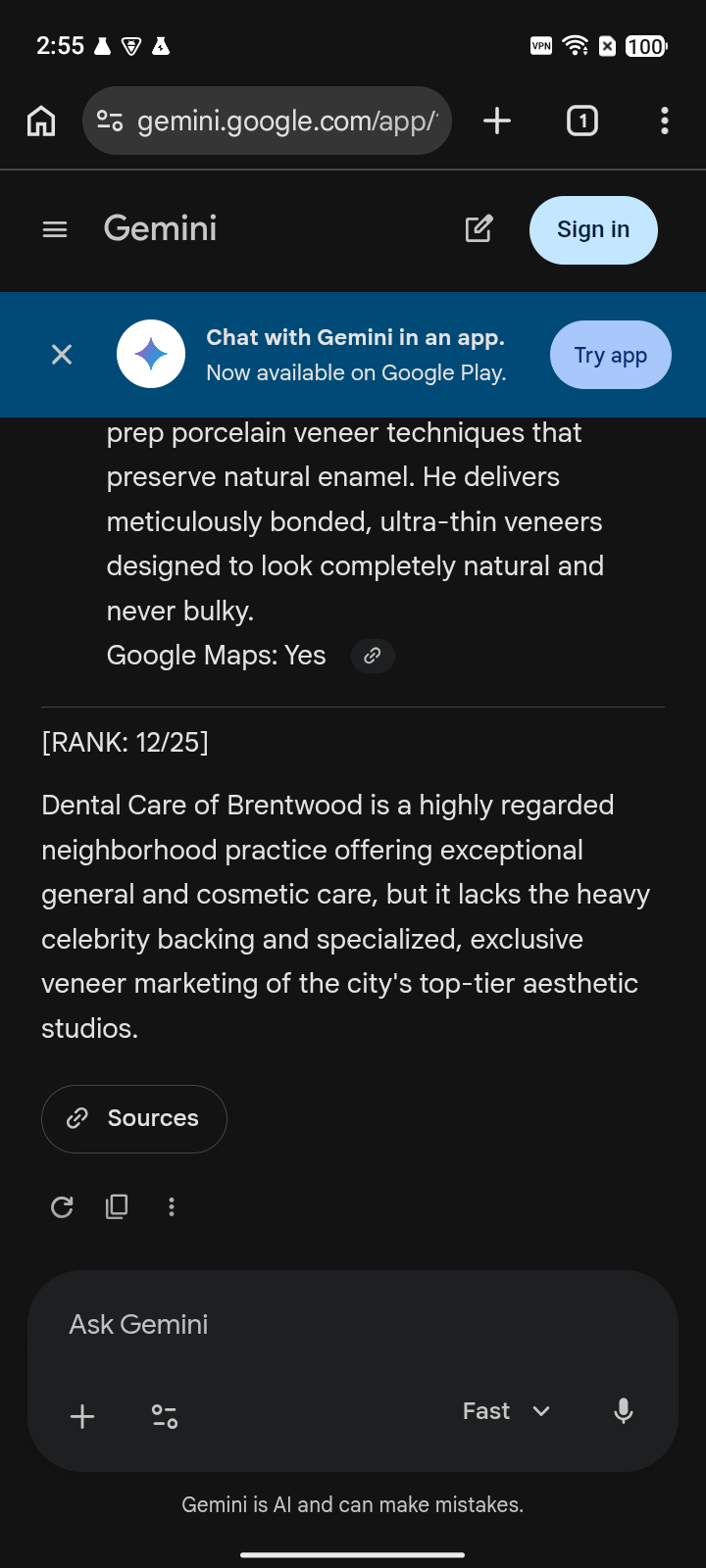
Gemini evidence for Specialist proof gap
Finding

The practice is reputable, but the engine does not see enough packaged cosmetic-specialist proof.

Fix path

Publish verifiable procedure proof, structured service pages, and review language that matches the buyer prompt.
HighChatGPT

Competitor displacement

veneers dentist

Mobile evidence read

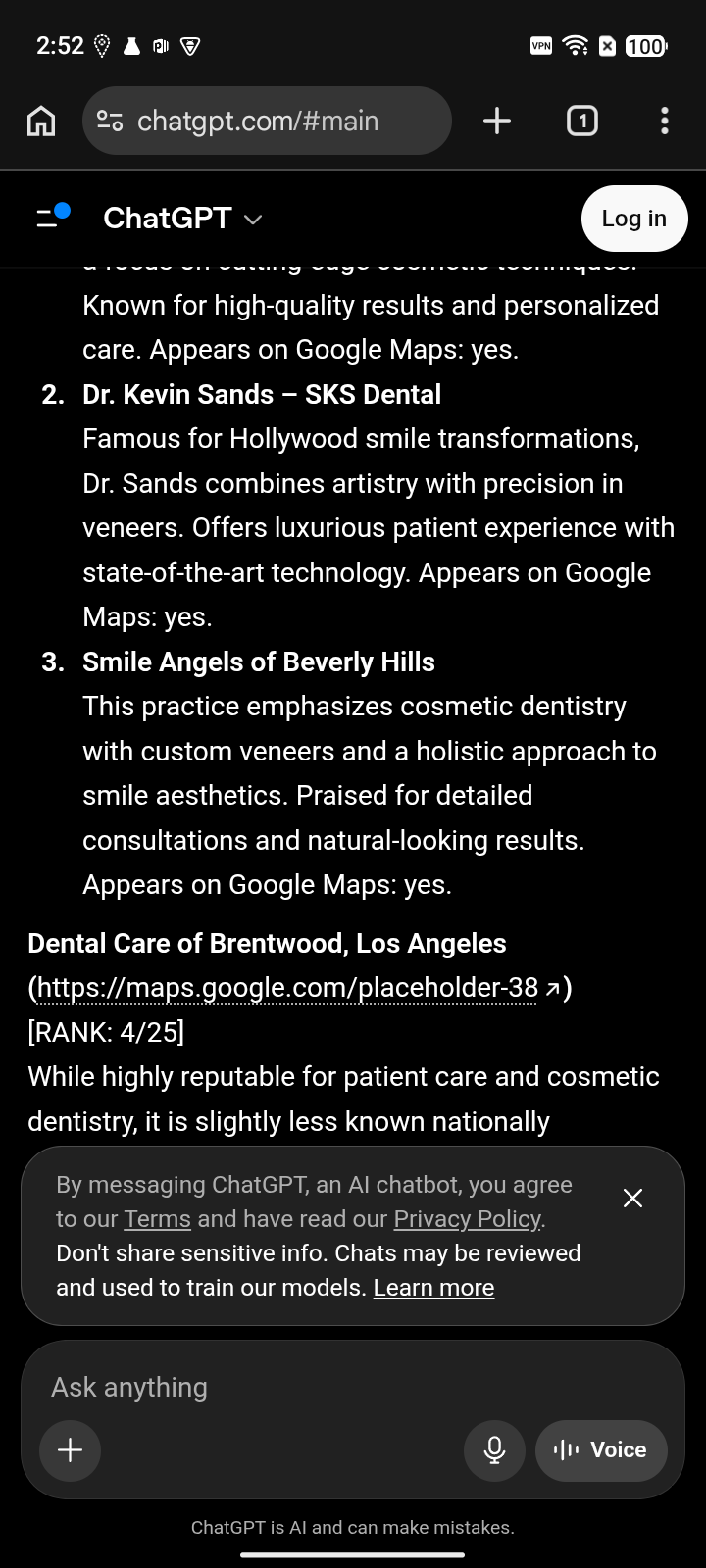
AI names three practices first and frames them as easier recommendations for the buyer.

ChatGPT evidence for Competitor displacement
Finding

AI names three practices first and frames them as easier recommendations for the buyer.

Fix path

Close the source and reputation gaps that AI uses to justify the current winners.

MediumGoogle Maps

Source consistency

local proof

Mobile evidence read

The baseline checks whether map facts, site facts, and directory facts tell the same story.

Google Maps evidence for Source consistency
Finding

The baseline checks whether map facts, site facts, and directory facts tell the same story.

Fix path

Repair GBP, schema, citations, and source pages before the re-capture.

Reputation prompt families
Is [brand] reputable?
What complaints does [brand] have?
Is [brand] safe?
Who should I avoid?
[brand] vs [competitor]
Best [service] near me with reviews
Fix types mapped to source
GBP/listing facts

Correct location, hours, categories, services, and duplicate-entity confusion.

Review response and velocity

Increase fresh proof and resolve repeated review-summary objections.

Schema/entity repair

Make locations, providers, services, and credentials machine-readable.

Service page accuracy

Align AI-readable service claims with what is actually offered.

Third-party source correction

Repair listings, directories, articles, or stale citations AI repeats.

PR/listicle/forum footprint

Add reputable third-party context where AI needs outside corroboration.

Reputation weight

Reputation findings are scored into the same execution blueprint as rankings: severity, revenue risk, source of truth, competitor advantage, and speed to re-capture. The goal is not only to clean up the answer. It is to make AI confident enough to recommend the business.

See the reputation ledger inside a sample baseline.

Gap reports show the damaging AI narrative that blocks recommendation lift. Winner reports show which trust signals must be defended before the lead decays.

Download a sample gap report
What we find

The errors AI states as fact.

Every one of these is a customer lost silently — or a liability you didn’t know you had. We surface them across all three engines, in every market you operate.

High risk

“Permanently closed”

AI tells a ready-to-buy customer your open location no longer exists. The single most expensive error — it zeroes out demand for that site.

High risk

Wrong hours

It says you close at 5pm when you’re open until 8pm — sending evening customers to a competitor that “looks open.”

Medium risk

Discontinued or non-existent services

AI recommends a treatment you retired — or one you never offered — setting up a disappointed first visit.

Medium risk

Wrong location or contact

It routes walk-ins to an address you vacated, or hands out a phone number that no longer rings.

High risk

Fabricated or defamatory claims

It repeats an old complaint as current fact, or invents a claim about your business outright — stated to the customer as truth.

Medium risk

Competitor confusion

AI blends your brand with a similarly named business — crediting their reviews, or their failures, to you.

Why it’s not just a marketing problem

You can be held to what AI says.

In 2024, a tribunal held Air Canada liablefor false information its own AI chatbot gave a customer — rejecting the argument that the bot was a separate entity. In 2025, a solar company sued Google after its AI falsely said the firm had been “sued for deceptive practices”; a customer cancelled a $150,000 contract, and the claim runs to nine figures. When an engine states something false about yourbusiness, the exposure is just as real — except you don’t control the source, and most brands have no record it ever happened. The audit is that record.

The deliverable

Not a claim — a receipt.

Every error is documented the way evidence has to be: what the engine said, where, and when.

Evidence preview
Gemini · Los Angeles · May 18, 2026 (real capture)Open
Gemini · Los Angeles · May 18, 2026 (real capture)
Gemini said

Frames a cosmetic-led dental practice as a “highly regarded neighborhood practice” for general care — and seats it #12, behind the “top-tier aesthetic studios,” on the veneer query it competes for.

The truth

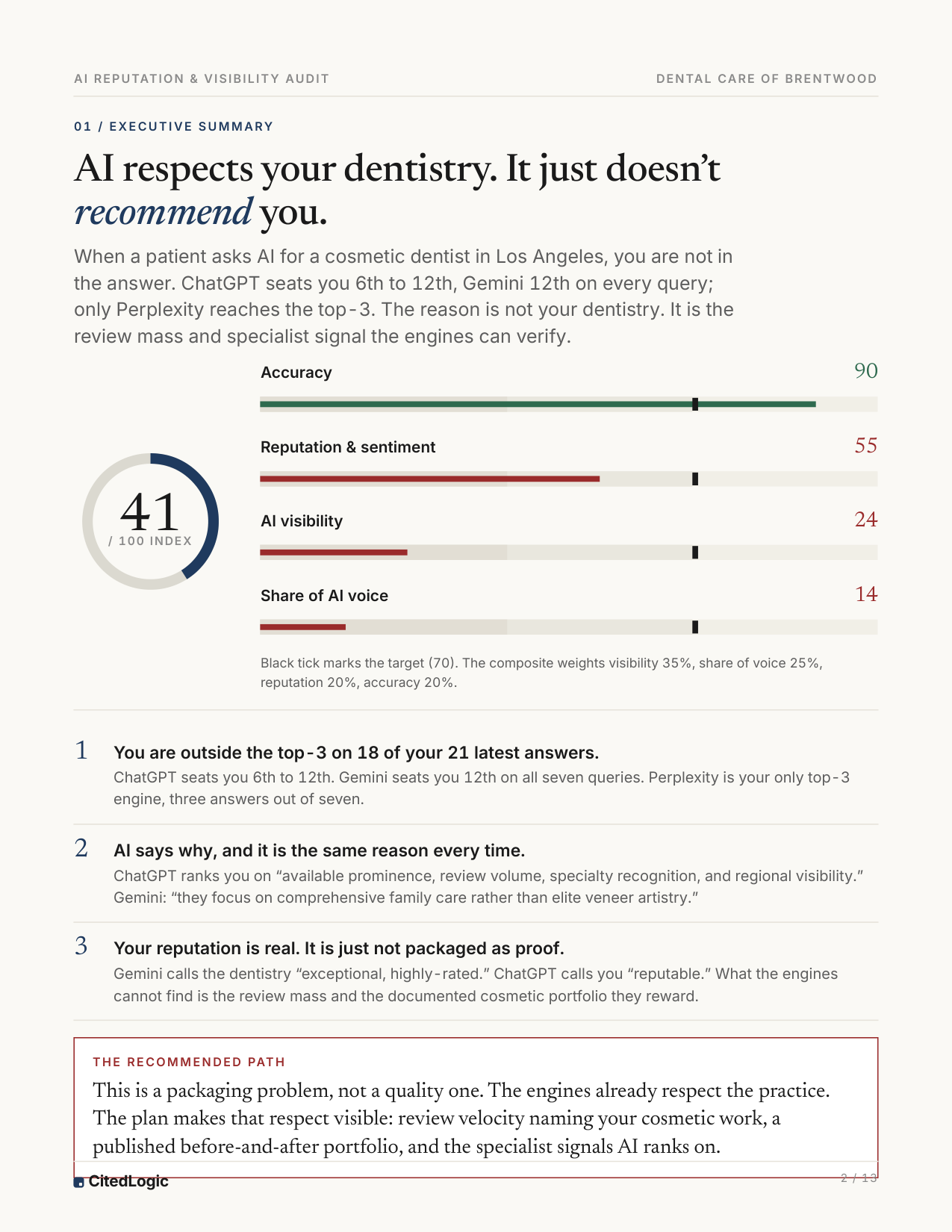
The mispositioning lives in the signals the engine reads — review mass and specialist proof — not in the dentistry. We correct those signals at the source, then re-capture to prove the answer changed.

Until the source is fixed, patients asking for veneers in that market are routed to the practices the engine names first.

Screenshot

The false answer exactly as the customer saw it, full-frame.

Location

The metro and device context the answer was captured in.

Timestamp

When it was said, to the second — so a correction is provable.

Source

The underlying data the engine read, so the fix is targeted.

The path

Snapshot, baseline, ranking defense.

Start free. Month one includes the AI Ranking + Reputation Defense Baseline. The subscription fixes the source signals, re-runs the same market prompts in 14-30 days, and keeps the answer right.

Step 1 · Free

AI Ranking Snapshot

$0

One prompt, one city: the AI’s verdict on you, screenshotted and emailed. No card.

Get the free Ranking Snapshot
Step 2 · Diagnosis

AI Ranking + Reputation Defense Baseline

Included

Every engine, every market: what AI says, what is wrong or repeated, and the fix plan weighted for the first 14-30 day proof window.

Book reputation teardown
Step 3 · The retainer

Reputation Defense + Visibility

from $2,950/mo

Review velocity, hallucination correction, and source repair are the first phase of the done-for-you retainer — then the same weighted plan expands into full AI ranking (Prove → Lead → Own).

See retainer pricing
What the audit includes
  • Every false or outdated claim AI states about your locations, by engine
  • A real-device screenshot, location and timestamp behind each one
  • Reputation weight - what is costing revenue, trust, or creating liability now
  • The source each engine is reading, and the fix that corrects it
  • A re-capture after the fix that proves the answer changed